

Back in December 2009, I wrote an article called Collaboration, Not Competition.
At the time, I was running a virtual assistant business, Twitter was still Twitter, and apparently I was worried about being kicked out of a networking group for missing three meetings.
A few things have changed. 😆
But when I recently reread the article, one thing surprised me: I still believe the central argument just as strongly today. I don’t want all the business. I want the right business.
And after more than two decades of running CyberCletch, I’ve learned that another good business succeeding doesn’t mean mine has to lose. In fact, sometimes the businesses we automatically label as competitors can become valuable sources of referrals, expertise, capacity, and entirely new opportunities.
Are They Really Your Competitor?
The original article started with a networking group I’d recently joined. I was excited about the group because the members I’d met seemed like fantastic people. Then the rules started arriving.
Three missed meetings and you’re out. And I was told I couldn’t promote my virtual assistant business because there were already several people in the group offering VA-type services.
There was one rather important problem with that logic: Nobody had asked what kind of work I did.
They didn’t know what services I specialized in, the customers I worked with, or how my business differed from the other virtual assistants in the room.
At the time, I compared it to assuming a divorce lawyer, tax lawyer, and criminal lawyer all do the same thing because they’re lawyers.
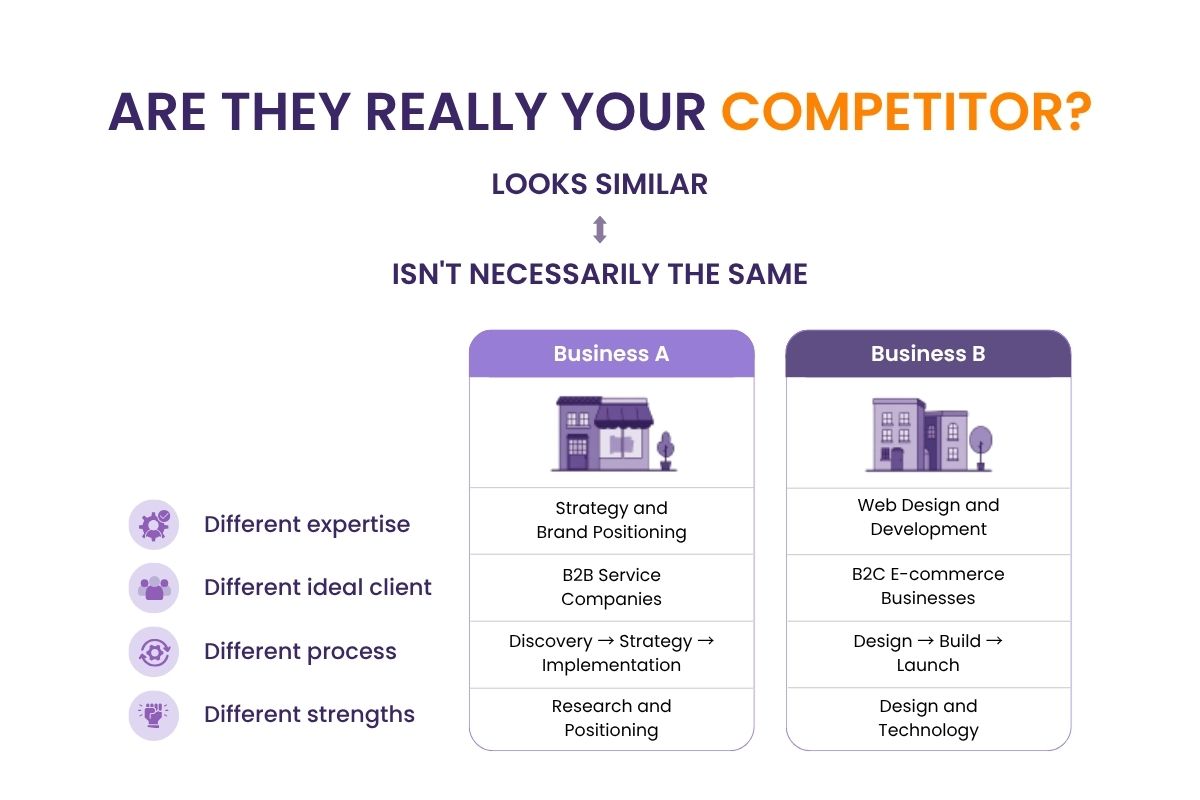
The same principle applies today. Two accountants can specialize in entirely different areas. Two therapists may work with completely different populations. Two contractors can take on very different types of projects. And two web companies can both build WordPress websites while having completely different expertise, processes, price points, philosophies, and ideal clients.
Offering similar services doesn’t make two businesses interchangeable. It may not even make them direct competitors.
Competition Can Help You Understand What Makes You Different
It’s easy to look at another business and ask: How do I compete with them?
I think there’s a better question: Why would the right customer choose me?
That’s a very different exercise.
Maybe you specialize in a particular industry. Maybe you’ve developed a process that works particularly well for a certain type of customer. Maybe you provide a level of personal involvement that a larger company can’t. Maybe your competitor offers something you deliberately don’t. Your experience, personality, communication style, values, pricing, processes, and approach to the work can all affect whether someone is a good fit.
And here’s something I think small businesses sometimes forget: Being different doesn’t require proving you’re better.
You don’t have to convince potential customers that every other choice is inferior. You simply need to help the right people understand why you’re particularly well suited to them. Competition can actually help clarify that.
Looking at businesses that offer similar services forces you to ask what makes yours different. And the better you can answer that question, the less threatening competition starts to feel.
You Don't Need Every Customer
This was probably the part of my 2009 article that sounded most like the business owner I would eventually become.
I wrote:
“I only have a limited number of hours in the day. I don’t want ALL the business.”
Nearly 17 years later, I still don’t.
There are only so many customers any small business can serve well. And not every potential customer should become your customer.
Sometimes the budget isn’t a fit. Sometimes the timeline isn’t realistic. Sometimes they need expertise you don’t have. Sometimes another business is simply better equipped to solve their particular problem. And yes, sometimes personalities, communication styles, or expectations don’t mesh.
None of that necessarily means there’s something wrong with the customer or your business. You’re just not the right match.
I’ve always wanted the people who work with CyberCletch to understand and value what we bring to the relationship. If someone needs something we’re not particularly good at providing, I’d rather help point them toward someone who is.
Which brings me to the people we’re supposed to be competing against.
Your Competitor Might Be Your Next Referral Partner
When I meet another business owner who does something similar to what I do, my first instinct isn’t to figure out how to keep customers away from them. I’m interested in the differences.
What are they exceptionally good at? Who do they like working with? What do they offer that we don’t? And is there work that comes my way that might be better suited to them? Because referrals can travel in both directions.
A business that isn’t right for one of my clients today may be exactly the resource I need tomorrow.
And collaboration can go much further than simply exchanging referrals. CyberCletch has worked with other agencies to provide expertise or capacity they don’t maintain in-house. They can expand what they’re able to offer their clients without adding permanent employees, while we gain access to projects and customers we might never have reached on our own. Both businesses can grow without either one needing to “win” at the other’s expense.
I’ve written more about how that works in practice in How to Grow Your Agency Without Hiring More Employees.
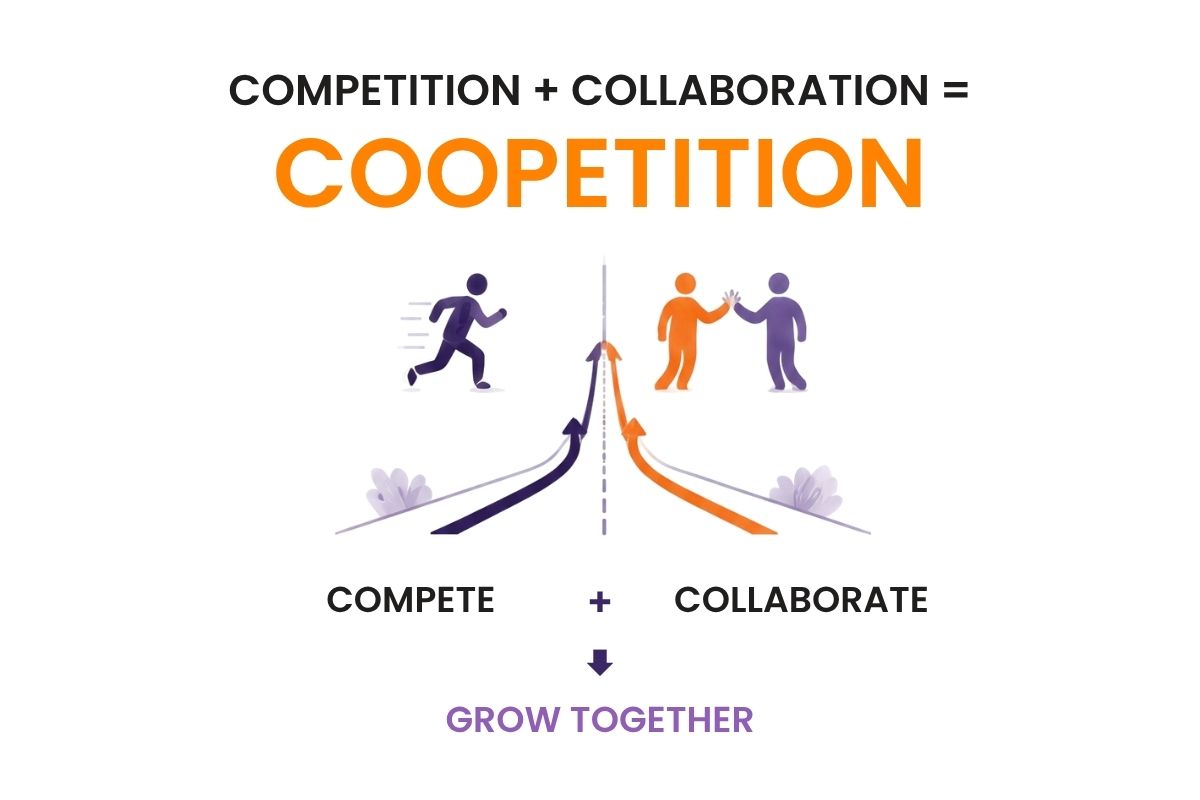
There’s actually a business term for simultaneously cooperating and competing: coopetition. And this isn’t just a nice philosophy. Research examining dozens of studies has found a positive relationship between coopetition and business performance. In other words, sometimes working with the coopetition is simply good business.
Collaboration Can Expand What's Possible
As a small business, there are limits to what you can do yourself.
You have limited time. Limited capacity. Limited expertise. And, despite what entrepreneurship culture occasionally suggests, you don’t have to become an expert at everything. Relationships with other businesses can help fill those gaps.
Someone else may have specialized expertise you only need occasionally. They may have capacity when you’re overwhelmed. They may serve a geographic market you don’t. Their service may complement yours in a way that allows both businesses to pursue larger opportunities. Or they may simply know something you don’t.
The original version of this article included a story about an SEO professional who blocked me on Twitter shortly after I tweeted:
“I love when I get to work on SEO for my real estate clients.”
I joked at the time that perhaps he was worried I’d follow him and learn all his secrets.
What struck me then still strikes me today. He apparently saw someone doing similar work and saw a threat. I saw someone I might eventually have been able to send work to.
Instead of asking “How do I protect myself from this person?”, what might happen if we occasionally asked: “Is there a way we could help each other?”
Collaboration Can Expand What's Possible
Collaboration doesn’t mean giving away the store.
Your customer information, confidential data, proprietary processes, intellectual property, pricing strategies, and other sensitive business information still need appropriate protection.
And not every competitor should become a collaborator.
Good collaborative relationships require many of the same things good customer relationships do:
Trust. Competence. Reliability. Ethics. Communication. Mutual respect.
The goal isn’t for everyone in your industry to hold hands around a campfire and sing Kumbaya.
Competition and collaboration aren’t mutually exclusive.
You can pay attention to your market, protect what you’ve built, compete for good business, and still recognize situations where working together makes everyone stronger.
Does Your Website Explain Why You're Different?
There’s another piece to this that we didn’t talk nearly enough about back in 2009. Your customers are comparing you whether you like it or not. They’re visiting websites, reading reviews, asking AI, looking at social media, and gathering recommendations.
The question isn’t whether they’ll discover your competitors. They will.
So take a look at your own real estate on the web. Can someone quickly understand who you’re best equipped to help? Does your website explain what you do particularly well? Does it communicate how you approach the work? Can someone get a sense of what it might actually be like to work with you? Or could your company name be replaced with a competitor’s and most of the copy would still work?
If your business sounds interchangeable with five others, having competitors isn’t necessarily the problem. The customer may simply not have enough information to understand the difference. Competition becomes much less intimidating when customers can see what makes you distinct.
Try Looking Sideways
Here’s an exercise I recently suggested to readers of my Connect. Convert. Exhale. newsletter.
Think of three businesses you consider competitors. Then resist the temptation to visit their websites simply to see what they’re doing better than you.
Instead, ask:
- Where are we similar, and where are we different?
- Who are they particularly well suited to serve?
- Who am I particularly well suited to serve?
- What expertise do they have that I don't?
- What do I offer that they don't?
- Is there a customer I'd happily refer to them?
- Could there be something we could accomplish together?
And then bring the exercise back home: Does my own website clearly communicate those differences?
You may discover that someone you’ve been watching as a competitor isn’t competing for quite the same business after all.
You may even discover an opportunity.
Collaboration, Not Competition—17 Years Later
Competition is real.
Markets change. Customers have choices. Businesses have to earn their place. I don’t think the answer is to pretend otherwise.
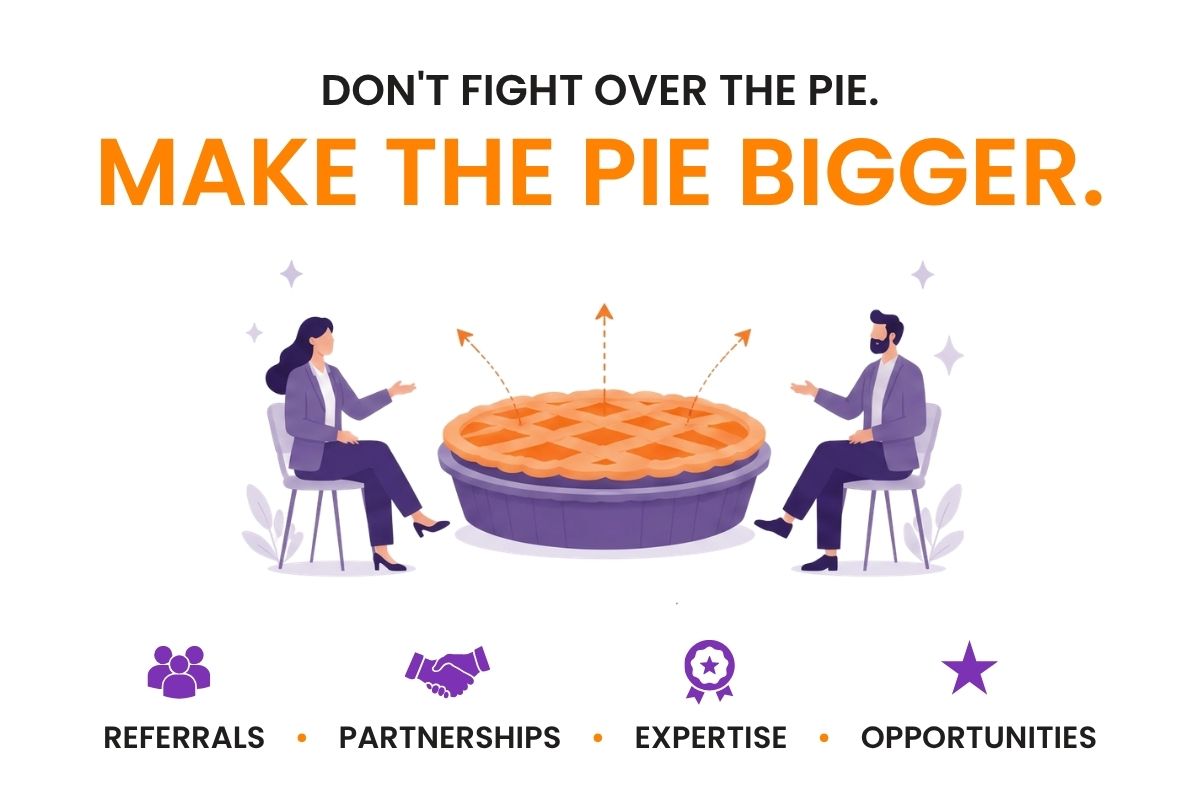
Pay attention to your competitors. Learn from them. Understand where your business fits within the market. But don’t become so focused on protecting your piece of the pie that you miss an opportunity to make the pie bigger.
When I wrote the original version of this article in December 2009, CyberCletch looked very different from the company it is today. The services have changed. The technology has certainly changed. And I’ve learned a few things along the way.
This hasn’t changed: I don’t need every customer.
I want the customers we’re particularly well equipped to help. And when we’re not the right fit, I’d much rather know someone trustworthy who is.
Nearly 17 years later, I still believe in collaboration, not competition.


SHARE:


